
Interventional Cardiology
Acute MI Angioplasty: Life-Saving Care When Every Second Counts
In the event of an Acute Myocardial Infarction (AMI)—commonly known as a heart attack—”Time is Muscle.” The sooner blood flow is restored to the heart, the less damage occurs to the heart muscle.
We specialize in Primary Angioplasty (Primary PCI), the global gold standard for treating severe heart attacks. Our 24/7 Emergency Cardiac Team is equipped to perform this life-saving procedure immediately upon your arrival.
What is Acute MI (Heart Attack)?
An Acute MI occurs when a coronary artery becomes completely blocked, usually by a blood clot forming over a ruptured plaque. This cuts off the oxygen supply to a section of the heart muscle.
- STEMI (ST-Elevation Myocardial Infarction): The most severe type of heart attack where the artery is totally blocked.
- NSTEMI: Partial blockage or blockage of a smaller artery.
Primary Angioplasty is the most effective treatment for STEMI patients to instantly reopen the blocked artery.
What is Primary Angioplasty (PAMI)?
Primary Angioplasty in Myocardial Infarction (PAMI) is an emergency angioplasty performed without delay during an evolving heart attack. Unlike elective angioplasty, which is scheduled, PAMI is a race against time.
The Procedure:
Emergency Access
The patient is rushed directly to the Catheterization Lab (Cath Lab).
Catheter Insertion
A thin tube is threaded through the wrist or groin to the blocked artery.
Clot Removal (Optional)
Sometimes, suction devices are used to remove the blood clot (Thrombectomy).
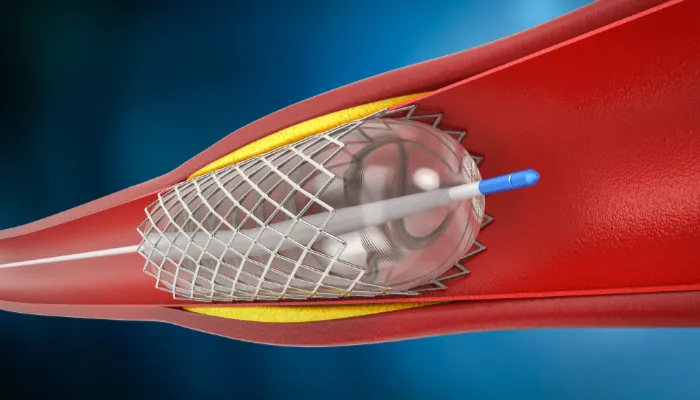
Balloon & Stent
A balloon is inflated to smash the blockage, and a Stent is placed to keep the artery open permanently, restoring blood flow instantly.
The "Golden Hour" & Door-to-Balloon Time
The success of an Acute MI Angioplasty depends heavily on speed.
- The Golden Hour: The first 60 minutes after the onset of heart attack symptoms. Treatment within this window offers the highest chance of full recovery.
- Door-to-Balloon Time: This is the time from when a patient enters the hospital doors to when the balloon is inflated in the blocked artery. Our facility targets a Door-to-Balloon time of less than 90 minutes, exceeding international standards.
Recognizing the Emergency: When to Call for Help
If you or a loved one experiences these symptoms, do not drive. Call Emergency Services immediately.
- Crushing Chest Pain: Pressure, squeezing, or fullness in the center of the chest lasting more than a few minutes.
- Radiating Pain: Pain spreading to the left arm, shoulder, jaw, neck, or back.
- Cold Sweat: Breaking out in a sudden, cold sweat without exertion.
- Shortness of Breath: Difficulty breathing, with or without chest pain.
- Nausea or Lightheadedness: Feeling sudden dizziness or the urge to vomit.
Important: Women and diabetic patients may experience “silent” heart attacks with milder symptoms like fatigue or indigestion.
Why Choose Us for Emergency Cardiac Care?
When facing a heart attack, the capability of the hospital matters.
- 24/7 Cath Lab: Our interventional lab never closes. We are staffed for emergencies on weekends, holidays, and usually late nights.
- Rapid Response Team: A dedicated team of cardiologists, nurses, and technicians activates the moment a "Code Blue" or cardiac alert is sounded.
- Advanced Technology: We utilize the latest drug-eluting stents and intravascular imaging to ensure precise placement even in emergency scenarios.
Recovery After Acute MI Angioplasty
- Immediate Post-Op: After the procedure, the patient is moved to the Coronary Care Unit (CCU) or ICU for close monitoring of heart rhythm and blood pressure.
- Hospital Stay: Most patients who undergo successful Primary Angioplasty are discharged within 3 to 5 days, provided there are no complications.
- Cardiac Rehabilitation: We provide a structured recovery plan, including medication management (antiplatelets), diet counseling, and safe physical activity guidelines to prevent future events.
Frequently Asked Questions
Is Primary Angioplasty better than Thrombolysis (Clot-busting drugs)?
Yes. While clot-busting drugs can be used if a hospital lacks a Cath Lab, Primary Angioplasty is mechanically superior. It opens the artery more fully and has a lower risk of the blockage returning or bleeding complications.
What happens if I arrive at the hospital late after a heart attack?
While the best results are achieved early, angioplasty can still be beneficial up to 12–24 hours after symptom onset to save remaining viable muscle and stabilize the heart.
Is the procedure safe during a heart attack?
Yes, it is the standard of care. However, because the patient is in a critical state, risks are slightly higher than elective procedures. Our specialists are trained to manage these high-risk scenarios.
In an Emergency? Contact Us Immediately
If you suspect a heart attack, do not wait.
